
Parasitism and pathogenesis; Development of disease in plants: Disease Triangle, Disease cycle.
परजीविता एवं रोगोत्पत्ति; पौधों में रोग का विकास: रोग त्रिकोण, रोग चक्र
Parasitism and Pathogenesis
परजीविता एवं रोगजनन
Parasitism is a biological relationship in which one organism, known as the parasite, lives on or inside another organism called the host and derives its nutrition at the expense of the host. In plant pathology, parasitism plays a central role in disease development because most plant pathogens such as fungi, bacteria, viruses, nematodes and parasitic plants depend on the host for survival and multiplication. The parasite establishes a close and often prolonged association with the host and may cause harm by extracting nutrients, secreting toxins, or interfering with normal physiological processes. This interaction between host and parasite determines the extent of disease development and severity.
परजीविता एक जैविक संबंध है जिसमें एक जीव, जिसे परजीवी कहा जाता है, दूसरे जीव जिसे होस्ट कहा जाता है, के ऊपर या अंदर रहकर उससे पोषण प्राप्त करता है। पौध रोग विज्ञान में परजीविता रोग के विकास में महत्वपूर्ण भूमिका निभाती है क्योंकि अधिकांश पौध रोगजनक जैसे फफूंद, बैक्टीरिया, वायरस, निमेटोड और परजीवी पौधे अपने जीवन और वृद्धि के लिए होस्ट पर निर्भर होते हैं। परजीवी होस्ट के साथ घनिष्ठ और लंबे समय तक संबंध स्थापित करता है और पोषक तत्वों को लेकर, विषाक्त पदार्थ स्रावित करके या सामान्य शारीरिक क्रियाओं में बाधा डालकर हानि पहुंचाता है। होस्ट और परजीवी के बीच यह परस्पर क्रिया रोग के विकास और उसकी तीव्रता को निर्धारित करती है।
Parasitism can be classified into different types based on the dependency and behavior of the parasite. Obligate parasites require a living host for their survival and cannot complete their life cycle without it, such as rust and powdery mildew fungi. Facultative parasites can live both as parasites and saprophytes depending on environmental conditions. Similarly, parasites may be ectoparasites, which live on the surface of the host, or endoparasites, which live inside the host tissues. Based on nutritional dependence, parasites are also categorized as biotrophs, necrotrophs and hemibiotrophs. Biotrophs obtain nutrients from living cells without killing them immediately, while necrotrophs kill host cells and then feed on dead tissues. Hemibiotrophs initially behave like biotrophs and later switch to necrotrophic mode.
परजीविता को परजीवी की निर्भरता और व्यवहार के आधार पर विभिन्न प्रकारों में वर्गीकृत किया जा सकता है। अनिवार्य परजीवी जीवित होस्ट के बिना जीवित नहीं रह सकते और अपना जीवन चक्र पूरा नहीं कर सकते, जैसे रस्ट और पाउडरी मिल्ड्यू फफूंद। वैकल्पिक परजीवी पर्यावरणीय परिस्थितियों के अनुसार परजीवी और सैप्रोफाइट दोनों रूप में रह सकते हैं। इसी प्रकार, परजीवी एक्टोपैरासाइट होते हैं जो होस्ट की सतह पर रहते हैं, या एंडोपैरासाइट जो होस्ट के ऊतकों के अंदर रहते हैं। पोषण निर्भरता के आधार पर परजीवियों को बायोट्रोफ, नेक्रोट्रोफ और हेमीबायोट्रोफ में भी वर्गीकृत किया जाता है। बायोट्रोफ जीवित कोशिकाओं से पोषण लेते हैं बिना उन्हें तुरंत मारे, जबकि नेक्रोट्रोफ होस्ट कोशिकाओं को मारकर मृत ऊतकों पर पोषण लेते हैं। हेमीबायोट्रोफ प्रारंभ में बायोट्रोफ की तरह व्यवहार करते हैं और बाद में नेक्रोट्रोफ बन जाते हैं।
Pathogenesis refers to the process by which a pathogen causes disease in a host plant. It includes all the events starting from the arrival of the pathogen on the host surface, its entry, colonization, multiplication, and ultimately the appearance of disease symptoms. Pathogenesis is a complex and dynamic process influenced by the genetic makeup of both host and pathogen, as well as environmental conditions. Successful pathogenesis requires compatibility between host and pathogen, where the pathogen can overcome the defense mechanisms of the host.
रोगजनन वह प्रक्रिया है जिसके द्वारा एक रोगजनक होस्ट पौधे में रोग उत्पन्न करता है। इसमें रोगजनक का पौधे की सतह पर पहुंचना, प्रवेश करना, बसना, वृद्धि करना और अंततः रोग के लक्षणों का प्रकट होना शामिल है। रोगजनन एक जटिल और गतिशील प्रक्रिया है जो होस्ट और रोगजनक दोनों की आनुवंशिक संरचना तथा पर्यावरणीय परिस्थितियों से प्रभावित होती है। सफल रोगजनन के लिए होस्ट और रोगजनक के बीच अनुकूलता आवश्यक होती है, जिसमें रोगजनक होस्ट की रक्षा प्रणाली को पार कर जाता है।
The process of pathogenesis involves several stages. The first stage is inoculation, where the pathogen comes in contact with the host. This is followed by penetration, where the pathogen enters the host through natural openings like stomata, wounds, or directly through the epidermis using mechanical pressure or enzymes. After penetration, the pathogen establishes itself inside the host tissues and begins to colonize by absorbing nutrients and spreading within the plant.
रोगजनन की प्रक्रिया में कई चरण शामिल होते हैं। पहला चरण इनोकुलेशन है, जिसमें रोगजनक होस्ट के संपर्क में आता है। इसके बाद प्रवेश होता है, जिसमें रोगजनक प्राकृतिक छिद्रों जैसे रंध्र, घाव या सीधे एपिडर्मिस के माध्यम से यांत्रिक दबाव या एंजाइमों की सहायता से प्रवेश करता है। प्रवेश के बाद रोगजनक होस्ट के ऊतकों के अंदर स्थापित हो जाता है और पोषक तत्वों को अवशोषित करते हुए तथा पौधे में फैलते हुए कॉलोनाइजेशन करता है।
During colonization, pathogens produce various enzymes and toxins that degrade host cell walls and disrupt normal cellular functions. Enzymes such as cellulases, pectinases, and proteases break down structural components of plant cells, facilitating pathogen spread. Toxins may interfere with metabolic processes, leading to cell death and symptom development. The interaction between pathogen virulence factors and host defense responses determines the outcome of infection.
कॉलोनाइजेशन के दौरान, रोगजनक विभिन्न एंजाइम और विषाक्त पदार्थ उत्पन्न करते हैं जो होस्ट की कोशिका भित्ति को तोड़ते हैं और सामान्य कोशिकीय क्रियाओं को बाधित करते हैं। सेलुलेज़, पेक्टिनेज और प्रोटीएज़ जैसे एंजाइम पौध कोशिकाओं के संरचनात्मक घटकों को तोड़ते हैं जिससे रोगजनक का फैलाव आसान हो जाता है। विषाक्त पदार्थ चयापचय प्रक्रियाओं में बाधा डालते हैं जिससे कोशिका मृत्यु और लक्षणों का विकास होता है। रोगजनक के विषाक्त कारकों और होस्ट की रक्षा प्रतिक्रिया के बीच की क्रिया संक्रमण के परिणाम को निर्धारित करती है।
Host plants possess various defense mechanisms to resist pathogen attack. These include physical barriers like cuticle and cell walls, and biochemical defenses such as production of phytoalexins, pathogenesis-related proteins, and reactive oxygen species. Some plants exhibit hypersensitive response, where infected cells rapidly die to restrict pathogen spread. However, successful pathogens have evolved mechanisms to evade or suppress these defenses, leading to disease development.
होस्ट पौधों में रोगजनकों के आक्रमण से बचने के लिए विभिन्न रक्षा तंत्र होते हैं। इनमें भौतिक अवरोध जैसे क्यूटिकल और कोशिका भित्ति, तथा जैव रासायनिक रक्षा जैसे फाइटोएलेक्सिन, रोगजनन संबंधित प्रोटीन और प्रतिक्रियाशील ऑक्सीजन प्रजातियों का उत्पादन शामिल है। कुछ पौधे हाइपरसेंसिटिव प्रतिक्रिया दिखाते हैं, जिसमें संक्रमित कोशिकाएं तेजी से मर जाती हैं ताकि रोगजनक का प्रसार रुक सके। हालांकि, सफल रोगजनक इन रक्षा तंत्रों से बचने या उन्हें दबाने के तरीके विकसित कर लेते हैं, जिससे रोग का विकास होता है।
Environmental factors such as temperature, humidity, rainfall, and soil conditions greatly influence parasitism and pathogenesis. Favorable environmental conditions enhance pathogen survival, reproduction, and infection efficiency, while unfavorable conditions limit disease development. Therefore, understanding the interaction between host, pathogen, and environment is essential for effective disease management.
तापमान, आर्द्रता, वर्षा और मृदा की स्थिति जैसे पर्यावरणीय कारक परजीविता और रोगजनन को बहुत प्रभावित करते हैं। अनुकूल पर्यावरणीय परिस्थितियां रोगजनक के जीवित रहने, प्रजनन और संक्रमण क्षमता को बढ़ाती हैं, जबकि प्रतिकूल परिस्थितियां रोग के विकास को सीमित करती हैं। इसलिए, प्रभावी रोग प्रबंधन के लिए होस्ट, रोगजनक और पर्यावरण के बीच संबंध को समझना आवश्यक है।
In conclusion, parasitism and pathogenesis are fundamental concepts in plant pathology that explain how diseases originate and develop in plants. A clear understanding of these processes helps in designing effective disease management strategies and improving crop health and productivity.
निष्कर्षतः, परजीविता और रोगजनन पौध रोग विज्ञान के मूलभूत सिद्धांत हैं जो यह बताते हैं कि पौधों में रोग कैसे उत्पन्न और विकसित होते हैं। इन प्रक्रियाओं की स्पष्ट समझ प्रभावी रोग प्रबंधन रणनीतियों को तैयार करने और फसल के स्वास्थ्य तथा उत्पादन में सुधार करने में सहायता करती है।
Development of Disease in Plants
पौधों में रोग का विकास
The development of disease in plants is a complex and dynamic process that involves a series of interactions between the host plant, the pathogen, and the environment. This interaction is commonly explained through the concept of the disease triangle, which emphasizes that disease occurs only when a susceptible host, a virulent pathogen, and a favorable environment are present simultaneously. If any one of these components is absent or unfavorable, the disease will not develop. Therefore, understanding the process of disease development is essential for effective plant disease management and crop protection.
पौधों में रोग का विकास एक जटिल और गतिशील प्रक्रिया है जिसमें होस्ट पौधा, रोगजनक और पर्यावरण के बीच विभिन्न प्रकार की पारस्परिक क्रियाएं शामिल होती हैं। इस संबंध को सामान्यतः रोग त्रिकोण के माध्यम से समझाया जाता है, जिसमें यह बताया जाता है कि रोग तभी उत्पन्न होता है जब संवेदनशील होस्ट, रोगजनक और अनुकूल पर्यावरण एक साथ उपस्थित हों। यदि इनमें से कोई भी घटक अनुपस्थित या प्रतिकूल हो, तो रोग का विकास नहीं होगा। इसलिए, रोग विकास की प्रक्रिया को समझना प्रभावी रोग प्रबंधन और फसल सुरक्षा के लिए अत्यंत आवश्यक है।
The process of disease development begins with inoculation, which refers to the arrival or contact of the pathogen with the host plant. Inoculum may consist of spores, bacterial cells, viral particles, or other infectious units. The success of inoculation depends on several factors such as the quantity of inoculum, environmental conditions, and the susceptibility of the host. Once the pathogen reaches the host surface, it must survive and establish itself to initiate infection.
रोग विकास की प्रक्रिया इनोकुलेशन से शुरू होती है, जिसका अर्थ है रोगजनक का होस्ट पौधे के संपर्क में आना। इनोकुलम में बीजाणु, बैक्टीरिया कोशिकाएं, वायरस कण या अन्य संक्रमणकारी इकाइयां शामिल हो सकती हैं। इनोकुलेशन की सफलता कई कारकों पर निर्भर करती है जैसे इनोकुलम की मात्रा, पर्यावरणीय परिस्थितियां और होस्ट की संवेदनशीलता। जब रोगजनक होस्ट की सतह पर पहुंचता है, तो उसे जीवित रहना और स्थापित होना आवश्यक होता है ताकि संक्रमण शुरू हो सके।
After inoculation, the next step is penetration, where the pathogen enters the host plant. Pathogens can enter through natural openings such as stomata, lenticels, or hydathodes, or through wounds caused by mechanical damage, insects, or other agents. Some pathogens can also directly penetrate the host surface by producing enzymes that degrade the cuticle and cell wall or by exerting mechanical pressure. Successful penetration is crucial for further colonization and disease progression.
इनोकुलेशन के बाद अगला चरण प्रवेश होता है, जिसमें रोगजनक पौधे के अंदर प्रवेश करता है। रोगजनक प्राकृतिक छिद्रों जैसे रंध्र, लेंटिसेल या हाइडैथोड के माध्यम से या यांत्रिक क्षति, कीट या अन्य कारकों द्वारा बने घावों के माध्यम से प्रवेश कर सकते हैं। कुछ रोगजनक एंजाइम उत्पन्न करके क्यूटिकल और कोशिका भित्ति को तोड़ते हैं या यांत्रिक दबाव डालकर सीधे प्रवेश करते हैं। सफल प्रवेश आगे के कॉलोनाइजेशन और रोग विकास के लिए आवश्यक होता है।
Following penetration, the pathogen establishes itself within the host tissues, a stage known as infection. During this stage, the pathogen begins to absorb nutrients from the host and multiplies within the plant. The pathogen spreads from cell to cell or through vascular tissues, depending on its nature. This stage is critical because it determines whether the infection will remain localized or become systemic, affecting the entire plant.
प्रवेश के बाद, रोगजनक होस्ट के ऊतकों के भीतर स्थापित हो जाता है, जिसे संक्रमण कहा जाता है। इस चरण में रोगजनक होस्ट से पोषक तत्वों को अवशोषित करता है और पौधे के अंदर बढ़ता है। रोगजनक अपनी प्रकृति के अनुसार कोशिका से कोशिका या संवहनी ऊतकों के माध्यम से फैलता है। यह चरण महत्वपूर्ण होता है क्योंकि यह निर्धारित करता है कि संक्रमण स्थानीय रहेगा या पूरे पौधे में फैल जाएगा।
During colonization, the pathogen actively grows and spreads within the host tissues. It produces enzymes such as cellulases, pectinases, and ligninases that break down the structural components of plant cells. Additionally, many pathogens produce toxins that disrupt normal cellular functions, leading to cell death and tissue damage. The interaction between pathogen virulence factors and host defense mechanisms determines the severity of the disease.
कॉलोनाइजेशन के दौरान, रोगजनक सक्रिय रूप से होस्ट के ऊतकों में बढ़ता और फैलता है। यह सेलुलेज़, पेक्टिनेज और लिग्निनेज जैसे एंजाइम उत्पन्न करता है जो पौध कोशिकाओं के संरचनात्मक घटकों को तोड़ते हैं। इसके अलावा, कई रोगजनक विषाक्त पदार्थ उत्पन्न करते हैं जो सामान्य कोशिकीय क्रियाओं को बाधित करते हैं, जिससे कोशिका मृत्यु और ऊतक क्षति होती है। रोगजनक के विषाक्त कारकों और होस्ट की रक्षा प्रणाली के बीच की क्रिया रोग की तीव्रता को निर्धारित करती है।
As the infection progresses, visible symptoms begin to appear on the plant. These symptoms may include chlorosis, necrosis, wilting, spots, blights, rots, and deformities. The type and severity of symptoms depend on the pathogen, host species, and environmental conditions. In some cases, symptoms may appear only after significant internal damage has occurred, making early detection difficult.
जैसे-जैसे संक्रमण बढ़ता है, पौधे पर दिखाई देने वाले लक्षण प्रकट होने लगते हैं। इन लक्षणों में क्लोरोसिस, नेक्रोसिस, मुरझाना, धब्बे, ब्लाइट, सड़न और विकृतियां शामिल हो सकती हैं। लक्षणों का प्रकार और तीव्रता रोगजनक, होस्ट प्रजाति और पर्यावरणीय परिस्थितियों पर निर्भर करती है। कुछ मामलों में, लक्षण तब दिखाई देते हैं जब अंदरूनी क्षति काफी अधिक हो चुकी होती है, जिससे प्रारंभिक पहचान कठिन हो जाती है।
The next stage in disease development is reproduction of the pathogen. During this phase, the pathogen produces reproductive structures such as spores, bacterial cells, or viral particles that can spread to new hosts. The spread of the pathogen can occur through various means such as wind, water, insects, tools, and human activities. This stage is crucial for the continuation of the disease cycle.
रोग विकास का अगला चरण रोगजनक का प्रजनन होता है। इस चरण में रोगजनक प्रजनन संरचनाएं जैसे बीजाणु, बैक्टीरिया कोशिकाएं या वायरस कण उत्पन्न करता है जो नए होस्ट में फैल सकते हैं। रोगजनक का प्रसार हवा, पानी, कीट, उपकरण और मानव गतिविधियों के माध्यम से हो सकता है। यह चरण रोग चक्र को जारी रखने के लिए महत्वपूर्ण होता है।
The final stage is survival or perennation, where the pathogen survives unfavorable environmental conditions. Pathogens may survive in plant debris, soil, seeds, or alternate hosts. Some produce resistant structures such as spores or sclerotia that can withstand harsh conditions. When favorable conditions return, these pathogens become active again and initiate new infections, completing the disease cycle.
अंतिम चरण जीवित रहना या स्थायित्व है, जिसमें रोगजनक प्रतिकूल पर्यावरणीय परिस्थितियों में जीवित रहता है। रोगजनक पौध अवशेषों, मृदा, बीज या वैकल्पिक होस्ट में जीवित रह सकते हैं। कुछ रोगजनक प्रतिरोधी संरचनाएं जैसे बीजाणु या स्क्लेरोटिया बनाते हैं जो कठोर परिस्थितियों को सहन कर सकते हैं। जब अनुकूल परिस्थितियां वापस आती हैं, तो ये रोगजनक फिर से सक्रिय हो जाते हैं और नए संक्रमण शुरू करते हैं, जिससे रोग चक्र पूरा होता है।
Environmental factors play a significant role in each stage of disease development. Temperature, humidity, rainfall, light, and soil conditions influence the growth and reproduction of pathogens as well as the susceptibility of the host. For example, high humidity favors fungal diseases, while dry conditions may limit their spread. Therefore, managing environmental conditions is an important strategy in disease control.
पर्यावरणीय कारक रोग विकास के प्रत्येक चरण में महत्वपूर्ण भूमिका निभाते हैं। तापमान, आर्द्रता, वर्षा, प्रकाश और मृदा की स्थिति रोगजनकों की वृद्धि और प्रजनन के साथ-साथ होस्ट की संवेदनशीलता को प्रभावित करते हैं। उदाहरण के लिए, उच्च आर्द्रता फफूंद रोगों के लिए अनुकूल होती है, जबकि शुष्क परिस्थितियां उनके प्रसार को सीमित कर सकती हैं। इसलिए, पर्यावरणीय परिस्थितियों का प्रबंधन रोग नियंत्रण की एक महत्वपूर्ण रणनीति है।
Host resistance also influences disease development. Resistant plants can prevent or slow down pathogen entry, colonization, and spread through structural and biochemical defenses. These defenses include thick cell walls, antimicrobial compounds, and rapid defense responses such as hypersensitive reaction. On the other hand, susceptible plants lack effective defense mechanisms, allowing pathogens to establish and cause disease easily.
होस्ट प्रतिरोध भी रोग विकास को प्रभावित करता है। प्रतिरोधी पौधे संरचनात्मक और जैव रासायनिक रक्षा के माध्यम से रोगजनक के प्रवेश, फैलाव और वृद्धि को रोक सकते हैं या धीमा कर सकते हैं। इन रक्षा तंत्रों में मोटी कोशिका भित्ति, एंटीमाइक्रोबियल यौगिक और हाइपरसेंसिटिव प्रतिक्रिया जैसी तेज प्रतिक्रियाएं शामिल हैं। दूसरी ओर, संवेदनशील पौधों में प्रभावी रक्षा तंत्र की कमी होती है, जिससे रोगजनक आसानी से स्थापित होकर रोग उत्पन्न करते हैं।
In conclusion, the development of disease in plants is a stepwise process involving inoculation, penetration, infection, colonization, symptom expression, reproduction, and survival. Each stage is influenced by the interaction between host, pathogen, and environment. A clear understanding of these stages helps in developing effective disease management strategies and reducing crop losses.
निष्कर्षतः, पौधों में रोग का विकास एक चरणबद्ध प्रक्रिया है जिसमें इनोकुलेशन, प्रवेश, संक्रमण, कॉलोनाइजेशन, लक्षण प्रकट होना, प्रजनन और जीवित रहना शामिल हैं। प्रत्येक चरण होस्ट, रोगजनक और पर्यावरण के बीच पारस्परिक क्रिया से प्रभावित होता है। इन चरणों की स्पष्ट समझ प्रभावी रोग प्रबंधन रणनीतियों के विकास और फसल हानि को कम करने में सहायता करती है।
Disease triangle
रोग त्रिकोण
Elements of Epidemic: epidemic develops as a result of timely combination of elements that result in plant disease, viz. susceptible host, virulent pathogen & favourable environmental conditions over a long period of time.
महामारी के तत्व: महामारी का विकास उन तत्वों के समय पर संयोजन के परिणामस्वरूप होता है जो पौधों में रोग उत्पन्न करते हैं, अर्थात संवेदनशील होस्ट, विषाणुशील रोगजनक और लंबे समय तक अनुकूल पर्यावरणीय परिस्थितियाँ।
Disease triangle: The interactions of three components of disease, i.e., the host, pathogen and environment, can be visualized as a disease triangle. The length of each side is proportional to the sum total of the characteristics of each component that favour disease. The interaction of susceptible host plant, virulent pathogen and favourable environmental conditions leads to the development of the disease
रोग त्रिकोण: रोग के तीन घटकों अर्थात होस्ट, रोगजनक और पर्यावरण के बीच की पारस्परिक क्रिया को रोग त्रिकोण के रूप में दर्शाया जा सकता है। प्रत्येक भुजा की लंबाई उन सभी गुणों के कुल योग के समानुपाती होती है जो रोग के अनुकूल होते हैं। संवेदनशील होस्ट पौधा, विषाणुशील रोगजनक और अनुकूल पर्यावरणीय परिस्थितियों की पारस्परिक क्रिया से रोग का विकास होता है।
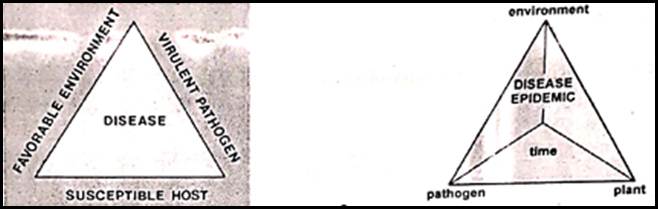
Disease Pyramid:
The disease triangle can be expanded to include two more components, time and humans.
रोग पिरामिड:
रोग त्रिकोण का विस्तार करके इसमें दो और घटक, समय और मानव को शामिल किया जा सकता है।
The amount of each of the three components of disease and their interaction in the development of the disease are affected by fourth component, time. Thus addition of time component to the disease triangle results into a tetrahedron or disease pyramid.
रोग के तीनों घटकों की मात्रा और उनके द्वारा रोग के विकास में होने वाली पारस्परिक क्रिया चौथे घटक अर्थात समय से प्रभावित होती है। इस प्रकार रोग त्रिकोण में समय घटक को जोड़ने से यह एक चतुष्फलकीय संरचना या रोग पिरामिड बन जाता है।
The effect of time on disease development becomes apparent when we consider the importance of time of year, the duration and frequency of favourable temperature and rain, the time of appearance of the vector, the duration of the cycle of a particular disease.
रोग के विकास पर समय का प्रभाव तब स्पष्ट होता है जब हम वर्ष के समय, अनुकूल तापमान और वर्षा की अवधि एवं आवृत्ति, वाहक के प्रकट होने का समय तथा किसी विशेष रोग के चक्र की अवधि के महत्व को ध्यान में रखते हैं।
➤ If the four components of disease pyramid could be quantified, its volume would be proportional to the amount of disease on a plant or in plant population.
यदि रोग पिरामिड के चारों घटकों को मात्रात्मक रूप से मापा जा सके, तो उसका आयतन पौधे या पौधों की जनसंख्या में रोग की मात्रा के समानुपाती होगा।
➤ Humans affect disease development in various ways. They affect the type of plants grown in an area, their level of resistance, time of planting, density of planting, etc.
मानव विभिन्न तरीकों से रोग के विकास को प्रभावित करते हैं। वे किसी क्षेत्र में उगाई जाने वाली फसलों के प्रकार, उनकी प्रतिरोध क्षमता, बोने का समय, पौधों की घनत्व आदि को प्रभावित करते हैं।
An epidemic may cause widespread and mass destruction of crop in a short time or may persist for long periods depending upon the three following factors responsible for the disease:
महामारी कम समय में फसल का व्यापक और बड़े स्तर पर विनाश कर सकती है या निम्नलिखित तीन कारकों पर निर्भर करते हुए लंबे समय तक बनी रह सकती है:
- Host होस्ट
- Pathogen रोगजनक and
- Environment पर्यावरण
1. HOST FACTORS
होस्ट कारक
i) Distance of susceptible plants from the source of primary inoculum: Longer the distance from the source of survival of the pathogen, longer will be the time required for the buildup of an Epiphytotic in a susceptible crop.
प्राथमिक इनोकुलम के स्रोत से संवेदनशील पौधों की दूरी: रोगजनक के जीवित रहने के स्रोत से दूरी जितनी अधिक होगी, संवेदनशील फसल में महामारी के निर्माण में उतना ही अधिक समय लगेगा।
ii) Abundance and distribution of susceptible hosts: Continuous cultivation of a susceptible variety over a large contiguous area helps in the buildup of the inoculum and improves the chances of epiphytotics.
संवेदनशील होस्ट की प्रचुरता और वितरण: बड़े क्षेत्र में लगातार संवेदनशील किस्म की खेती इनोकुलम के संचय में मदद करती है और महामारी की संभावना को बढ़ाती है।
iii) Disease proneness in the host due to environment: Susceptibility is genetically controlled but the disease proneness in the plant to get infected can be induced by environment and other factors (Host nutrition, excessive application of nitrogenous fertilizers, etc).
पर्यावरण के कारण होस्ट में रोग के प्रति प्रवृत्ति: संवेदनशीलता आनुवंशिक रूप से नियंत्रित होती है, लेकिन पौधे में संक्रमण की प्रवृत्ति पर्यावरण और अन्य कारकों (जैसे पोषण, नाइट्रोजन उर्वरकों का अत्यधिक उपयोग आदि) द्वारा बढ़ाई जा सकती है।
iv) Presence of suitable alternate or collateral hosts: These host plants help in the survival of inoculum of different pathogens in off season. Presence of Barbery which is an alternate host to Puccinia graminis tritici helps in the heterogenous infection chain. Presence of grass hosts helps in the survival of Pyricularia oryzae in the off-season.
उपयुक्त वैकल्पिक या सहायक होस्ट की उपस्थिति: ये होस्ट पौधे विभिन्न रोगजनकों के इनोकुलम को ऑफ-सीजन में जीवित रहने में मदद करते हैं। Barbery की उपस्थिति, जो Puccinia graminis tritici का वैकल्पिक होस्ट है, विषम संक्रमण श्रृंखला में सहायता करती है। घास के होस्ट की उपस्थिति Pyricularia oryzae के ऑफ-सीजन में जीवित रहने में मदद करती है।
v) Genetic resistance or Susceptibility of Host.
-Vertical Resistance
-Horizontal Resistance
होस्ट की आनुवंशिक प्रतिरोधकता या संवेदनशीलता।
-ऊर्ध्वाधर प्रतिरोध
-क्षैतिज प्रतिरोध
| SNo | Feature | Vertical Resistance | Horizontal Resistance |
| 1 | Pathotype-specificity | Race specific | Race nonspecific |
| 2 | Nature of gene action | Vertical resistance, conferred by the R-genes, is oligogenic, and can be overcome by a change of race. | Horizontal resistance polygenic, and acts against all races of blight. |
| 3 | Response to pathogen | Monogenic or Oligogenic, usually hypersensitive resistant response | Polygenic; rarely oligogenic |
| 4 | Effect on disease development | Vertical resistance reduces the initial amount of inoculum from which the epidemic begins. | Horizontal resistance slows down the rate at which disease increases in the field. |
| 5 | Phenotypic expression | Qualitative | Quantitative |
| 6 | Stage of expression | Seedling to maturity | Expression increases as plant matures (Adult plant) |
| 7 | Selection and evaluation | Relatively easy | Relatively difficult |
| 8 | Risk of “boom and burst” | Present (rarely durable) | Absent (durable) |
| 9 | Suitable for: a. Host b. Pathogen | Annuals but not perennials; Immobile pathogen, e.g., Soil pathogens, but not for mobile air-borne pathogens | Both annuals and perennials; All pathogens |
| 10 | Need for specific deployment of resistant varieties | Critical for success with mobile pathogens | None |
| 11 | Need for other control measures | Likely | Much less likely |
| 12 | Host-pathogen interaction | Present | Absent |
| 13 | Efficiency | Highly efficient against specific races | Variable, but operates against all races |
vi) Degree of genetic uniformity of host in a particular field.
Monoculture, especially clones
किसी विशेष खेत में होस्ट की आनुवंशिक समानता की मात्रा।
एकल फसल प्रणाली, विशेषकर क्लोन
vii) Types of crops
Annual crops & foliar diseases develop much more rapidly(in weeks).
Perennial woody diseases take longer time to develop(in years).
फसलों के प्रकार
वार्षिक फसलों में एवं पर्णीय रोग बहुत तेजी से विकसित होते हैं (सप्ताहों में)।
बहुवर्षीय काष्ठीय पौधों के रोगों को विकसित होने में अधिक समय लगता है (वर्षों में)।
viii) Age of Host plants
Some plants are susceptible only during growth period & become resistant during mature period
होस्ट पौधों की आयु
कुछ पौधे केवल वृद्धि काल के दौरान संवेदनशील होते हैं और परिपक्व अवस्था में प्रतिरोधी हो जाते हैं।
2. PATHOGEN FACTORS:
रोगजनक कारक:
i) Presence of virulent/aggressive isolate of a pathogen: For any epiphytotic, rapid cycle of infection is essential, and successful infection can be caused only by virulent isolates of the pathogen…
रोगजनक के विषाणुशील/आक्रामक आइसोलेट की उपस्थिति: किसी भी महामारी के लिए संक्रमण का तेज चक्र आवश्यक होता है, और सफल संक्रमण केवल रोगजनक के विषाणुशील आइसोलेट द्वारा ही हो सकता है।
ii) High birth rate: The pathogen that assume epiphytotic form invariably have the capacity to produce enormous quantity of spores that are adapted to long distance dissemination in a short time.
उच्च जन्म दर: वे रोगजनक जो महामारी का रूप धारण करते हैं, उनमें अत्यधिक मात्रा में बीजाणु उत्पन्न करने की क्षमता होती है जो कम समय में लंबी दूरी तक फैलने के लिए अनुकूलित होते हैं।
iii) Low death rate of the pathogen: Epiphytotics is attributed to low death rate of the pathogens in those in which the causal agent is systemic and protected by the plant tissues.
रोगजनक की कम मृत्यु दर: महामारी उन रोगजनकों में कम मृत्यु दर के कारण होती है जिनमें कारण जीव प्रणालीगत होता है और पौध ऊतकों द्वारा संरक्षित रहता है।
iv) Mode of spread of the pathogen (Easy and rapid dispersal of the pathogen favours epidemic): The ability of a pathogen to cause epiphytotics is much more dependent on its dispersal rate. Eg., Strong wind-Most sudden and widespread epidemics.
Viruses disseminated by insect vectors
Bacteria dispersed through rain splashes and water
Pathogen spread through soil- Slow spreading disease.
रोगजनक के फैलने का तरीका (रोगजनक का आसान और तेज प्रसार महामारी को बढ़ावा देता है): किसी रोगजनक की महामारी उत्पन्न करने की क्षमता उसके प्रसार की दर पर अधिक निर्भर करती है। उदाहरण, तेज हवा-अधिकांश अचानक और व्यापक महामारियां।
वायरस कीट वाहकों द्वारा फैलते हैं
बैक्टीरिया वर्षा के छींटों और पानी द्वारा फैलते हैं
मृदा के माध्यम से फैलने वाले रोगजनक-धीमी गति से फैलने वाले रोग।
v) Type of reproduction of the pathogen.
Monocyclic
Polycyclic (responsible for most sudden, catastrophic Epidemics)
Polyetic
रोगजनक के प्रजनन का प्रकार।
मोनोसाइक्लिक
पॉलीसाइक्लिक (अधिकांश अचानक और विनाशकारी महामारियों के लिए जिम्मेदार)
पॉलीएटिक
vi) Adaptability of the pathogen: Most of the pathogens causing epiphytotics adapt themselves to various adverse conditions.
रोगजनक की अनुकूलन क्षमता: अधिकांश रोगजनक जो महामारी उत्पन्न करते हैं, विभिन्न प्रतिकूल परिस्थितियों के अनुकूल स्वयं को ढाल लेते हैं।
3) WEATHER FACTORS:
मौसम संबंधी कारक:
➤ Weather conditions such as, optimum temperature, moisture, light, etc., are very essential for the development of an epidemic
मौसम की परिस्थितियां जैसे उपयुक्त तापमान, नमी, प्रकाश आदि महामारी के विकास के लिए अत्यंत आवश्यक हैं।
Moisture Rain, dew, high humidity (dominant factor in disease caused by oomycetes, fungi, bacteria & nematode.)
नमी वर्षा, ओस, उच्च आर्द्रता (ओमाइसीट्स, फफूंद, बैक्टीरिया और निमेटोड द्वारा उत्पन्न रोगों में प्रमुख कारक है।)
Temperature: Affects disease cycles of pathogens.
तापमान: रोगजनकों के रोग चक्र को प्रभावित करता है।
4) HUMAN ACTIVITIES:
मानव गतिविधियां:
Site of selection & preparation: Low lying and poorly drain fields (near to infection fields) helps in epidemic. Selection of propagative material.
स्थान का चयन और तैयारी: निचले और खराब जल निकास वाले खेत (संक्रमित खेतों के पास) महामारी में सहायता करते हैं। प्रवर्धन सामग्री का चयन।
➤ Introduction of exotic pathogens विदेशी रोगजनकों का परिचय
Culture Practices: continuous monoculture, use of high dose of N- fertilizers, Dense Planting, overhead irrigation and poor sanitaion all increase the chance of epidemic.
सांस्कृतिक प्रथाएं: निरंतर एकल फसल, नाइट्रोजन उर्वरकों की अधिक मात्रा का उपयोग, सघन रोपण, ऊपर से सिंचाई और खराब स्वच्छता सभी महामारी की संभावना को बढ़ाते हैं।
➤ Disease control measures.
➤ रोग नियंत्रण उपाय।
5) TIME: समय:
Season of the year
वर्ष का मौसम
Duration & frequency of favourable temp & rains.
अनुकूल तापमान और वर्षा की अवधि और आवृत्ति।
Disease Cycle
रोग चक्र
The disease cycle refers to the sequence of events through which a plant pathogen survives, spreads, infects, multiplies, and again survives to initiate new infections in subsequent seasons. It is a continuous process that explains the development of disease in plants over time. Understanding the disease cycle is very important in plant pathology because it helps in identifying critical stages where effective control measures can be applied to break the cycle and reduce disease incidence.
रोग चक्र उन घटनाओं के क्रम को दर्शाता है जिनके माध्यम से एक पौध रोगजनक जीवित रहता है, फैलता है, संक्रमण करता है, वृद्धि करता है और फिर से जीवित रहकर अगले मौसम में नए संक्रमण शुरू करता है। यह एक सतत प्रक्रिया है जो समय के साथ पौधों में रोग के विकास को समझाती है। पौध रोग विज्ञान में रोग चक्र को समझना बहुत महत्वपूर्ण है क्योंकि इससे उन महत्वपूर्ण चरणों की पहचान होती है जहां प्रभावी नियंत्रण उपाय लागू करके चक्र को तोड़ा जा सकता है और रोग की घटना को कम किया जा सकता है।
Stages of Disease Cycle
रोग चक्र के चरण
The disease cycle consists of several important stages, each contributing to the development and spread of disease. These stages are interconnected and form a complete cycle.
रोग चक्र कई महत्वपूर्ण चरणों से मिलकर बना होता है, जिनमें से प्रत्येक रोग के विकास और प्रसार में योगदान देता है। ये सभी चरण आपस में जुड़े होते हैं और एक पूर्ण चक्र बनाते हैं।
1. Survival or Perennation of Pathogen
रोगजनक का जीवित रहना या स्थायित्व
The first stage of the disease cycle is the survival of the pathogen during unfavorable conditions such as extreme temperature, drought, or absence of host plants. Pathogens adopt various survival mechanisms to persist in adverse conditions. They may survive in soil, plant debris, seeds, alternate hosts, or in the form of resistant structures such as spores, sclerotia, chlamydospores, or cysts.
रोग चक्र का पहला चरण प्रतिकूल परिस्थितियों जैसे अत्यधिक तापमान, सूखा या होस्ट पौधों की अनुपस्थिति के दौरान रोगजनक का जीवित रहना है। रोगजनक प्रतिकूल परिस्थितियों में बने रहने के लिए विभिन्न तरीकों को अपनाते हैं। वे मृदा, पौध अवशेष, बीज, वैकल्पिक होस्ट या प्रतिरोधी संरचनाओं जैसे बीजाणु, स्क्लेरोटिया, क्लैमाइडोस्पोर या सिस्ट के रूप में जीवित रह सकते हैं।
This stage ensures that the pathogen remains viable until favorable conditions return. Without this survival stage, the pathogen would not be able to continue its life cycle.
यह चरण सुनिश्चित करता है कि रोगजनक तब तक जीवित रहे जब तक अनुकूल परिस्थितियां वापस न आ जाएं। इस चरण के बिना रोगजनक अपना जीवन चक्र जारी नहीं रख पाएगा।
2. Production of Primary Inoculum
प्राथमिक इनोकुलम का निर्माण
Primary inoculum refers to the initial infectious units that start the disease in a new growing season. These may include fungal spores, bacterial cells, nematode eggs, or viral particles. The primary inoculum is produced from survival structures or previously infected plant materials.
प्राथमिक इनोकुलम उन प्रारंभिक संक्रमणकारी इकाइयों को कहते हैं जो नए फसल मौसम में रोग की शुरुआत करते हैं। इनमें फफूंद के बीजाणु, बैक्टीरिया कोशिकाएं, निमेटोड अंडे या वायरस कण शामिल हो सकते हैं। प्राथमिक इनोकुलम जीवित रहने वाली संरचनाओं या पहले से संक्रमित पौध अवशेषों से उत्पन्न होता है।
The availability and amount of primary inoculum greatly influence the initiation and severity of disease.
प्राथमिक इनोकुलम की उपलब्धता और मात्रा रोग की शुरुआत और उसकी तीव्रता को बहुत प्रभावित करती है।
3. Dissemination of Inoculum
इनोकुलम का प्रसार
Dissemination is the process by which the inoculum is spread from one place to another. Pathogens are dispersed through various agents such as wind, water, insects, animals, tools, and human activities.
प्रसार वह प्रक्रिया है जिसके द्वारा इनोकुलम एक स्थान से दूसरे स्थान तक फैलता है। रोगजनक हवा, पानी, कीट, पशु, उपकरण और मानव गतिविधियों के माध्यम से फैलते हैं।
Efficient dissemination increases the chances of infection and contributes to rapid disease spread, especially under favorable environmental conditions.
प्रभावी प्रसार संक्रमण की संभावना को बढ़ाता है और अनुकूल पर्यावरणीय परिस्थितियों में रोग के तेजी से फैलाव में योगदान देता है।
4. Inoculation
इनोकुलेशन
Inoculation is the process by which the pathogen comes into contact with the host plant. This is the first step toward infection.
इनोकुलेशन वह प्रक्रिया है जिसमें रोगजनक होस्ट पौधे के संपर्क में आता है। यह संक्रमण की दिशा में पहला कदम है।
The success of inoculation depends on factors such as environmental conditions, host susceptibility, and pathogen virulence.
इनोकुलेशन की सफलता पर्यावरणीय परिस्थितियों, होस्ट की संवेदनशीलता और रोगजनक की विषाणुशीलता पर निर्भर करती है।
5. Penetration
प्रवेश
After inoculation, the pathogen must enter the host plant to establish infection. Pathogens may enter through natural openings like stomata, lenticels, and hydathodes, or through wounds. Some pathogens can directly penetrate the plant surface using mechanical pressure and enzymes.
इनोकुलेशन के बाद रोगजनक को संक्रमण स्थापित करने के लिए पौधे के अंदर प्रवेश करना होता है। रोगजनक प्राकृतिक छिद्रों जैसे रंध्र, लेंटिसेल और हाइडैथोड या घावों के माध्यम से प्रवेश कर सकते हैं। कुछ रोगजनक यांत्रिक दबाव और एंजाइमों की सहायता से सीधे पौधे की सतह में प्रवेश करते हैं।
Successful penetration is essential for further development of the disease.
सफल प्रवेश रोग के आगे के विकास के लिए आवश्यक है।
6. Infection and Colonization
संक्रमण और कॉलोनाइजेशन
Infection occurs when the pathogen successfully establishes itself inside the host tissues. During colonization, the pathogen grows, multiplies, and spreads within the plant.
संक्रमण तब होता है जब रोगजनक सफलतापूर्वक होस्ट के ऊतकों के अंदर स्थापित हो जाता है। कॉलोनाइजेशन के दौरान रोगजनक पौधे के अंदर बढ़ता, गुणा करता और फैलता है।
Pathogens produce enzymes and toxins that help in breaking down plant tissues and facilitating their spread.
रोगजनक एंजाइम और विषाक्त पदार्थ उत्पन्न करते हैं जो पौध ऊतकों को तोड़ने और उनके प्रसार में सहायता करते हैं।
7. Symptom Development
लक्षणों का विकास
As the pathogen grows and spreads, visible symptoms appear on the plant. These symptoms may include spots, wilting, chlorosis, necrosis, rots, and deformities.
जैसे-जैसे रोगजनक बढ़ता और फैलता है, पौधे पर दिखाई देने वाले लक्षण प्रकट होते हैं। इन लक्षणों में धब्बे, मुरझाना, क्लोरोसिस, नेक्रोसिस, सड़न और विकृतियां शामिल हो सकती हैं।
The type and severity of symptoms depend on the host, pathogen, and environmental conditions.
लक्षणों का प्रकार और तीव्रता होस्ट, रोगजनक और पर्यावरणीय परिस्थितियों पर निर्भर करती है।
8. Secondary Inoculum and Secondary Cycles
द्वितीयक इनोकुलम और द्वितीयक चक्र
In many diseases, the pathogen produces secondary inoculum after initial infection. This leads to repeated cycles of infection within the same growing season, known as secondary cycles.
कई रोगों में प्रारंभिक संक्रमण के बाद रोगजनक द्वितीयक इनोकुलम उत्पन्न करता है। इससे उसी फसल मौसम में बार-बार संक्रमण होता है, जिसे द्वितीयक चक्र कहा जाता है।
Diseases with multiple cycles are called polycyclic diseases and can spread rapidly, causing severe epidemics.
जिन रोगों में कई चक्र होते हैं उन्हें पॉलीसाइक्लिक रोग कहा जाता है और वे तेजी से फैलकर गंभीर महामारी उत्पन्न कर सकते हैं।
9. Survival and Continuation of Cycle
चक्र का पुनः जीवित रहना और निरंतरता
At the end of the growing season, the pathogen again enters the survival stage to withstand unfavorable conditions. This ensures the continuation of the disease cycle in the next season.
फसल मौसम के अंत में रोगजनक फिर से प्रतिकूल परिस्थितियों को सहन करने के लिए जीवित रहने की अवस्था में प्रवेश करता है। इससे अगले मौसम में रोग चक्र की निरंतरता सुनिश्चित होती है।
Types of Disease Cycles
रोग चक्र के प्रकार
1. Monocyclic Disease Cycle:
In this type, the pathogen completes only one infection cycle in a season. The disease depends mainly on primary inoculum.
मोनोसाइक्लिक रोग चक्र:
इस प्रकार में रोगजनक एक मौसम में केवल एक संक्रमण चक्र पूरा करता है। रोग मुख्य रूप से प्राथमिक इनोकुलम पर निर्भर करता है।
2. Polycyclic Disease Cycle:
In this type, the pathogen completes several infection cycles in a single season due to the production of secondary inoculum.
पॉलीसाइक्लिक रोग चक्र:
इस प्रकार में रोगजनक द्वितीयक इनोकुलम के कारण एक ही मौसम में कई संक्रमण चक्र पूरा करता है।
3. Polyetic Disease Cycle:
In this type, disease development occurs over several years, and inoculum builds up gradually.
पॉलीएटिक रोग चक्र:
इस प्रकार में रोग का विकास कई वर्षों में होता है और इनोकुलम धीरे-धीरे बढ़ता है।
DOWNLOD PDF OPEN
PPATH-122 Notes PDF FUNDAMENTALS OF PLANT PATHOLOGY 6th Deans Download