
Bacteria and mollicutes: general morphological characters
जीवाणु एवं मोलिक्यूट्स: सामान्य आकृतिक लक्षण
Morphology, Cytology and other characters:
Bacteria are the microscopic, possess rigid cellwall, unicellular, prokaryotic protists lacking chlorophyll and divide chiefly by transverse binary fission. Among the major characteristics of bacterial cells are their size, shape, structure and arrangement, which
constitute the morphology of the cell.
बैक्टीरिया सूक्ष्म होते हैं, इनमें कठोर कोशिका भित्ति होती है, ये एककोशिकीय, प्रोकैरियोटिक प्रोटिस्ट होते हैं जिनमें क्लोरोफिल नहीं होता और ये मुख्यतः अनुप्रस्थ द्विखंडन द्वारा विभाजित होते हैं। बैक्टीरिया कोशिकाओं की मुख्य विशेषताएँ उनका आकार, आकृति, संरचना और व्यवस्था होती हैं, जो
कोशिका की आकृति विज्ञान बनाती हैं।
Different morphological form of Bacteria
i Micrococci ii Diplococci iii Streptococci iv Saphylicocci v. Sarchina vi Rod-shaped bacteria vii Sprilla viii Vibrios
बैक्टीरिया के विभिन्न आकार
i माइक्रोकोक्की ii डिप्लोकोक्की iii स्ट्रेप्टोकोक्की iv सैफाइलोकोक्की v सार्सिना vi दण्डाकार बैक्टीरिया vii स्पिरिला viii विब्रियो
I) General structure of bacaterial cell: The main components of a bacteria call are (1) Capsule, (2) cell well (3) Cytoplasmic membrane (4) Cytoplams, (5) Nuclear region (6) Flagellum. (7) Pilli
- Capsule: In many bacteria cells develop an enclosing cover of gummy/material forming a layer of considerable thickness. This layer is known as capsule or smile layer. Capsule serves as reservoir of food and site for disposal of waste substances. Chemically, it is polysaccharide in nature. It protects the bacterial cell during adverse condition.
I) बैक्टीरियल कोशिका की सामान्य संरचना: बैक्टीरिया कोशिका के मुख्य भाग हैं (1) कैप्सूल, (2) कोशिका भित्ति (3) साइटोप्लाज्मिक झिल्ली (4) साइटोप्लाज्म, (5) नाभिकीय क्षेत्र (6) फ्लैजेलम (7) पिली
कैप्सूल: कई बैक्टीरिया कोशिकाओं में एक चिपचिपा पदार्थ का आवरण बनता है जो मोटी परत बनाता है। इस परत को कैप्सूल या स्लाइम लेयर कहते हैं। कैप्सूल भोजन के भंडार और अपशिष्ट पदार्थों के निष्कासन के स्थान के रूप में कार्य करता है। रासायनिक रूप से यह पॉलीसैकेराइड प्रकृति का होता है। यह प्रतिकूल परिस्थितियों में बैक्टीरिया कोशिका की रक्षा करता है।
- Cell wall: It is a thin, sharply defined, and relatively firm structure beneath the capsule. Bacterial cell wall is rather stable and resistant to the action of most substances except strong acids and alkalis. All the food material which enters in to the cell must diffuse through the cell wall. It is composed of complex carbohydrates, cellulose, chitin, and other polysaccharides.
कोशिका भित्ति: यह कैप्सूल के नीचे स्थित एक पतली, स्पष्ट और अपेक्षाकृत कठोर संरचना होती है। बैक्टीरिया की कोशिका भित्ति काफी स्थिर होती है और मजबूत अम्ल व क्षार को छोड़कर अधिकांश पदार्थों के प्रभाव से सुरक्षित रहती है। कोशिका में प्रवेश करने वाला सारा भोजन कोशिका भित्ति से होकर गुजरता है। यह जटिल कार्बोहाइड्रेट, सेलूलोज, काइटिन और अन्य पॉलीसैकेराइड से बनी होती है।
Bacterial cell wall is rigid and gives definite shape to bacterial cell. Peptidoglycan, a polymer present in the cell wall determine the shape and offers rigidity to cell wall. Cell wall thickness ranges from 10 to 25 nm. Cell wall Constitutes 10 to 40% dry weight of bacterial cell. Bacterial cell wall has two functions.
- It gives definite shape to bacterial cell.
- It is essential for growth and division.
बैक्टीरिया की कोशिका भित्ति कठोर होती है और कोशिका को निश्चित आकार देती है। कोशिका भित्ति में उपस्थित पेप्टिडोग्लाइकन नामक पॉलिमर कोशिका का आकार निर्धारित करता है और उसे कठोरता प्रदान करता है। कोशिका भित्ति की मोटाई 10 से 25 nm तक होती है। यह बैक्टीरिया की शुष्क भार का 10 से 40% भाग बनाती है। बैक्टीरिया की कोशिका भित्ति के दो कार्य होते हैं।
यह बैक्टीरिया कोशिका को निश्चित आकार देती है।
यह वृद्धि और विभाजन के लिए आवश्यक होती है।
Peptidoglycan is rigidity giving principle of cell wall. It is polymer of a) DPA-diaminopimelic acid b) Muramic acid and c) Techoic acid.
In addition to this it is also contains amino acid, amino sugars, carbohydrates and lipids. Above chemicals join to form polymer of Peptidoglycan.Major building blocks of Peptidoglycan are as below:
- AGA (Acetyl glucose amine)
- AMA (Acetyl muramic acid)
- Peptide: containing four or five types of acids.
पेप्टिडोग्लाइकन कोशिका भित्ति को कठोरता प्रदान करता है। यह a) DPA-डायएमिनोपिमेलिक अम्ल b) म्यूरामिक अम्ल और c) टेकोइक अम्ल का पॉलिमर होता है।
इसके अलावा इसमें अमीनो अम्ल, अमीनो शर्करा, कार्बोहाइड्रेट और लिपिड भी होते हैं। ये सभी मिलकर पेप्टिडोग्लाइकन का निर्माण करते हैं। पेप्टिडोग्लाइकन के मुख्य घटक निम्न हैं: - AGA (एसीटाइल ग्लूकोज अमीन)
- AMA (एसीटाइल म्यूरामिक अम्ल)
पेप्टाइड: जिसमें चार या पाँच प्रकार के अम्ल होते हैं।
On the basis of structure and chemical composition of cell wall, bacteria are divided in to two groups:
- Gram+ve bacteria
- Gram-ve bacteria
कोशिका भित्ति की संरचना और रासायनिक संरचना के आधार पर बैक्टीरिया को दो समूहों में बांटा जाता है:
ग्राम धनात्मक बैक्टीरिया
ग्राम ऋणात्मक बैक्टीरिया
1) Gram +ve bacteria:
Cell wall of such bacteria contains an insoluble polymer called Peptidoglycan Peptidoglycan has major portion of techoic acid and unipartite layered cell wall c.g Bacillus subtilis.
ग्राम धनात्मक बैक्टीरिया:
ऐसे बैक्टीरिया की कोशिका भित्ति में पेप्टिडोग्लाइकन नामक अघुलनशील पॉलिमर होता है। इसमें टेकोइक अम्ल की मात्रा अधिक होती है और इसकी कोशिका भित्ति एक परत वाली होती है, जैसे Bacillus subtilis।
2) Gram-ve bacteria:
In addition to Peptidoglycan such bacteria also have lipopolysaccharide, in their cell wall which is endotoxin and determines antigenecity, toxigenocity and sensitivity to bacteriophase. Chemically gram-ve wall being complex, contain higher lipid portion and more amino acids. Under electron microscope cell wall shows tripartite structure c.g Escherchia coli.
ग्राम ऋणात्मक बैक्टीरिया:
पेप्टिडोग्लाइकन के अलावा ऐसे बैक्टीरिया की कोशिका भित्ति में लिपोपॉलीसैकेराइड भी होता है, जो एंडोटॉक्सिन होता है और एंटीजनिकता, विषाक्तता तथा बैक्टीरियोफेज के प्रति संवेदनशीलता निर्धारित करता है। रासायनिक रूप से ग्राम ऋणात्मक कोशिका भित्ति जटिल होती है, जिसमें अधिक लिपिड और अमीनो अम्ल होते हैं। इलेक्ट्रॉन माइक्रोस्कोप में इसकी कोशिका भित्ति तीन परतों वाली दिखाई देती है, जैसे Escherchia coli।
Functions of cell wall:
- Protection of protoplast
- Maintenance of elongate shape of bacilli
- helps in flagellar motion
- Exerts selective permeability.
कोशिका भित्ति के कार्य:
प्रोटोप्लास्ट की सुरक्षा
बैसिलस के लम्बे आकार को बनाए रखना
फ्लैजेलम की गति में सहायता करना
चयनात्मक पारगम्यता प्रदान करना
- Cytoplasmic membrane or Plasma membrane: Extremely thin but distinct membrane surrounding the cytoplasm. It functions as selective membrane; controls passage of nutrients and waste products. Responsible for gram staining reactions.
साइटोप्लाज्मिक झिल्ली या प्लाज्मा झिल्ली: यह साइटोप्लाज्म को घेरने वाली बहुत पतली लेकिन स्पष्ट झिल्ली होती है। यह चयनात्मक झिल्ली के रूप में कार्य करती है और पोषक तत्वों तथा अपशिष्ट पदार्थों के आवागमन को नियंत्रित करती है। यह ग्राम स्टेनिंग क्रिया के लिए भी जिम्मेदार होती है।
- Cytoplasm: Inside the cytoplasmic membrane there is a colloidal substance containing 70-90 percent water, known as cytoplasm. It is usually clear or watery or slightly viscous in consistency. Cytoplasmic inclusions consist of
i) Granules of stored food particles like carbohydrates.
ii) Droplets of fat may be found distributed into cytoplasm.
Metachromatic granules of organic metaphosphate may also be present.
iv) Elementary sulphur is also present in the cells of certain sulphur bacteria in the form of drop lets. Cytoplasmic area RNA and Nuclear area – DNA.
साइटोप्लाज्म: साइटोप्लाज्मिक झिल्ली के अंदर एक कोलॉइडल पदार्थ होता है जिसमें 70-90 प्रतिशत पानी होता है, जिसे साइटोप्लाज्म कहते हैं। यह सामान्यतः साफ, पानी जैसा या थोड़ा गाढ़ा होता है। साइटोप्लाज्मिक समावेशन में शामिल हैं
i) कार्बोहाइड्रेट जैसे संग्रहीत भोजन कणों के ग्रेन्यूल्स।
ii) वसा की बूंदें साइटोप्लाज्म में पाई जाती हैं।
ऑर्गेनिक मेटाफॉस्फेट के मेटाक्रोमैटिक ग्रेन्यूल्स भी पाए जा सकते हैं।
iv) कुछ सल्फर बैक्टीरिया की कोशिकाओं में प्राथमिक सल्फर बूंदों के रूप में पाया जाता है। साइटोप्लाज्मिक भाग में RNA और नाभिकीय भाग में DNA होता है।
- Nucleus: Presence of nucleus has been established with certainly only a few years back. It has been shown that all bacteria contain intracellular bodies with the chemical properties expected of DNA which divide in co ordination with the division of the cell. By following special staining methods with the help of electron microscope, it has been possible to demonstrate the bacterial nucleus. Although composition is still unsettled one It is however shown that the nucleus consists of tiny granules of chromatin scattered through out the cytoplasm.
नाभिक: नाभिक की उपस्थिति कुछ ही वर्षों पहले निश्चित रूप से स्थापित की गई है। यह पाया गया है कि सभी बैक्टीरिया में DNA के गुणों वाले अंतःकोशिकीय भाग होते हैं जो कोशिका विभाजन के साथ विभाजित होते हैं। इलेक्ट्रॉन माइक्रोस्कोप की सहायता से विशेष स्टेनिंग विधियों द्वारा बैक्टीरिया के नाभिक को दिखाया जा सकता है। यद्यपि इसकी संरचना पूरी तरह स्पष्ट नहीं है, फिर भी यह पाया गया है कि नाभिक छोटे-छोटे क्रोमैटिन कणों से बना होता है जो साइटोप्लाज्म में फैले रहते हैं।
- Flagella: They are the organs of locomotion. Most commonly bacterial motility is due to the presence of hairlike appendages known as flagella. The flagella vibrate actively and thus propel the organism forward.
फ्लैजेला: ये गति के अंग होते हैं। सामान्यतः बैक्टीरिया की गति बाल जैसे उपांगों के कारण होती है जिन्हें फ्लैजेला कहते हैं। फ्लैजेला सक्रिय रूप से कंपन करते हैं और जीव को आगे बढ़ाते हैं।
- Pilli (Fimbriae): These are smaller, shorter, numerous, hairlike structures as compared to flagella. They cannot produce regular waves. They are visible only with electron microscope and are present in motile bacteria. Pilli have following three functions:
1. They are helpful in adherence to host.
2 They make possible attachment of bacteriophage on bacterial surface.
3 Sex pilli serve as conjugation tube in sexual reproduction of bacteria
e.g. special ‘F’ pilus in E. coli.
पिली (फिम्ब्रिया): ये फ्लैजेला की तुलना में छोटे, कम लंबे और अधिक संख्या में पाए जाने वाले बाल जैसे संरचनाएँ हैं। ये नियमित तरंगें उत्पन्न नहीं कर सकतीं। ये केवल इलेक्ट्रॉन माइक्रोस्कोप से दिखाई देती हैं और गतिशील बैक्टीरिया में पाई जाती हैं। पिली के तीन कार्य होते हैं:
ये होस्ट से चिपकने में सहायता करती हैं।
ये बैक्टीरियोफेज के बैक्टीरिया की सतह पर जुड़ने में मदद करती हैं।
सेक्स पिली बैक्टीरिया के लैंगिक प्रजनन में संयुग्मन नलिका का कार्य करती हैं, जैसे E. coli में विशेष ‘F’ पिलस।
- Plasmid: In addition to chromosomal DNA many bacteria contain extrachromosomal DNA in closed circular double strands form. This unit of genetic material capable of independent replications called plasmid. Plasmids are found in almost every known type of bacterial cell. Most of the plasmids are dispensable i.e. they are not required for survival of cell in which they reside. In many cases, however, they are essential under certain environmental condition such as in the presence of an antibiotic, these helps to tide over the unfavourable environmental condition. Their role in modern biotechnology have opened a new era of genetic engineering. Plasmids are autonomous genetic element.
प्लाज्मिड: क्रोमोसोमल DNA के अलावा कई बैक्टीरिया में एक्स्ट्राक्रोमोसोमल DNA भी होता है जो बंद वृत्ताकार दोहरी श्रृंखला के रूप में होता है। यह आनुवंशिक पदार्थ की इकाई जो स्वतंत्र रूप से प्रतिकृति बना सकती है, प्लाज्मिड कहलाती है। प्लाज्मिड लगभग सभी प्रकार के बैक्टीरिया में पाए जाते हैं। अधिकांश प्लाज्मिड आवश्यक नहीं होते, यानी वे कोशिका के जीवित रहने के लिए जरूरी नहीं होते। लेकिन कई परिस्थितियों में, जैसे एंटीबायोटिक की उपस्थिति में, ये महत्वपूर्ण हो जाते हैं और प्रतिकूल परिस्थितियों से बचने में मदद करते हैं। आधुनिक जैव प्रौद्योगिकी में इनकी भूमिका ने जेनेटिक इंजीनियरिंग के नए युग की शुरुआत की है। प्लाज्मिड स्वायत्त आनुवंशिक तत्व होते हैं।
II) Size of Bacteria and its measurements:
Dimensions of micro-organisms are expressed in terms of micro millimeter, abbreviated to micron. One micron is equal to one millionth of a meter. It is 0.001 mm or 0.0001 cm.
बैक्टीरिया का आकार और उसका मापन:
सूक्ष्मजीवों के आयाम माइक्रो मिलीमीटर में व्यक्त किए जाते हैं, जिसे माइक्रोन कहा जाता है। एक माइक्रोन एक मीटर का दस लाखवां भाग होता है। यह 0.001 मिमी या 0.0001 सेमी के बराबर होता है।
Although different species of bacteria vary in size and shape, of each species is constant. Bacteria commonly studied, have size ranging between 0.2 to 0.5 in diameter and 1 to 5µ in length. One trillion bacteria can be arranged in one cubic centimeter. (one trillion one million million).
यद्यपि बैक्टीरिया की विभिन्न प्रजातियों का आकार और आकृति अलग-अलग होती है, लेकिन प्रत्येक प्रजाति का आकार स्थिर होता है। सामान्यतः अध्ययन किए जाने वाले बैक्टीरिया का व्यास 0.2 से 0.5 माइक्रोन और लंबाई 1 से 5 माइक्रोन होती है। एक घन सेंटीमीटर में एक ट्रिलियन बैक्टीरिया समा सकते हैं।
III) Shape of Bacterial cells:
Four types of cells are found amongst the bacteria
Spherical
- Rod shaped
- Spiral
- Filamentous.
बैक्टीरिया कोशिकाओं का आकार:
बैक्टीरिया में चार प्रकार की कोशिकाएँ पाई जाती हैं
गोलाकार
दण्डाकार
सर्पिल
तंतुमय
- Spherical organism is designated as Bacillus.
गोलाकार जीव को Bacillus कहा जाता है।
- A rod-shaped organism is designated as Bacillus.
दण्डाकार जीव को Bacillus कहा जाता है।
- A spiral organism is designated as Spirillum.
सर्पिल जीव को Spirillum कहा जाता है।
- The term tricho bacteria includes those forms which develop as long or branched bacteria. filamentous
ट्राइको बैक्टीरिया शब्द उन रूपों के लिए प्रयोग किया जाता है जो लंबे या शाखित बैक्टीरिया के रूप में विकसित होते हैं। तंतुमय
Arrangement and grouping of bacterial cells: The bacterial cells are surrounded by a thin (rarely thick) layer of gelatinous material which tends to keep the cells together.
The grouping of cells largely depends upon the manner of multiplication and the direction of the planes of division. It is a general rule that the wall that divides bacterial cell into two daughter cells is formed at right angles to the longer axis. Since Cocci have no longest axis, cell division may occur in any direction.
बैक्टीरिया कोशिकाओं की व्यवस्था और समूह बनाना: बैक्टीरिया कोशिकाएँ एक पतली (कभी-कभी मोटी) जिलेटिनस परत से घिरी होती हैं जो कोशिकाओं को एक साथ बनाए रखती है।
कोशिकाओं का समूह मुख्य रूप से विभाजन के तरीके और विभाजन की दिशा पर निर्भर करता है। सामान्य नियम यह है कि जो दीवार बैक्टीरिया कोशिका को दो पुत्री कोशिकाओं में विभाजित करती है, वह लंबी धुरी के समकोण पर बनती है। चूंकि कोक्की में लंबी धुरी नहीं होती, इसलिए उनका विभाजन किसी भी दिशा में हो सकता है।
A) Grouping in Cocci: कोक्की में समूह बनाना:
Micrococcus: When daughter cells separate out soon after their formation.
माइक्रोकोक्कस: जब पुत्री कोशिकाएँ बनने के तुरंत बाद अलग हो जाती हैं।- Diplococcus: When the cells remain attached in pairs.
डिप्लोकोक्कस: जब कोशिकाएँ जोड़े में जुड़ी रहती हैं। - Streptococcus Here successive planes of division are constantly parallel and thus results in a chain of cells.
स्ट्रेप्टोकोक्कस: इसमें विभाजन की समतल रेखाएँ समानांतर रहती हैं और कोशिकाओं की श्रृंखला बनती है। - tetrads: four cells, cling together forming a square.
टेट्राड: चार कोशिकाएँ मिलकर वर्ग बनाती हैं। - Sarcina: cells clinging together in cubes made up of eight or its multiple (Cell division in three)
सार्सिना: कोशिकाएँ आठ या अधिक के घन के रूप में जुड़ी रहती हैं (तीन दिशाओं में विभाजन)। - Staphyllococcus: When the cells remain attached in irregular masses resembling a bunch of grapes.
स्टैफाइलोकोक्कस: जब कोशिकाएँ अंगूर के गुच्छे जैसी अनियमित संरचना बनाती हैं।
B) Grouping in Bacillus: The rod-shaped bacteria may be long or short, usually straight, i may also be somewhat curved. It may have rounded ends or may be even concave.
Grouping is possible in bacillus because of the division is only in one plane.
- Microbacillus: Separate rods.
- Pallisade: The cells form group in pallisade, like the matchsticks filled in matchbo e.g Corynebacterium diptheriae
- Streptotacillus: Rods in chain.
बैसिलस में समूह बनाना: दण्डाकार बैक्टीरिया लंबे या छोटे हो सकते हैं, सामान्यतः सीधे होते हैं, कभी-कभी थोड़े मुड़े हुए भी हो सकते हैं। इनके सिरे गोल या अवतल हो सकते हैं।
बैसिलस में समूह बनना संभव है क्योंकि इनका विभाजन केवल एक ही दिशा में होता है।
माइक्रोबैसिलस: अलग-अलग दण्ड।
पैलिसेड: कोशिकाएँ माचिस की तीलियों की तरह समूह बनाती हैं, जैसे Corynebacterium diptheriae
स्ट्रेप्टोबैसिलस: दण्ड श्रृंखला में जुड़े होते हैं।
C) Grouping in spirillum.
No grouping in spirillum. They may be thin, broad, short or long.
स्पिरिलम में समूह बनाना:
स्पिरिलम में कोई समूह नहीं बनता। ये पतले, चौड़े, छोटे या लंबे हो सकते हैं।
D) Tricho bacterium: Consists of long threads which may be branched or unbranched Branching may be true or false.
ट्राइको बैक्टीरिया: यह लंबे धागे जैसे होते हैं जो शाखित या बिना शाखा के हो सकते हैं। शाखाएँ वास्तविक या आभासी हो सकती हैं।
Involution forms: Consistency of form is usually a marked feature of bacteria during its early stages of growth, but in old cultures and under certain conditions which are not favorable for the growth, bacteria may attain abnormal or unusual shapes such as thread like filaments, or club shape etc. these are termed as involution forms. Certain species of bacteria show this character much more readily than others e.g. Root nodule bacteria.
इनवोल्यूशन रूप: सामान्यतः वृद्धि के प्रारंभिक चरणों में बैक्टीरिया का आकार स्थिर रहता है, लेकिन पुरानी संस्कृतियों में और कुछ प्रतिकूल परिस्थितियों में, बैक्टीरिया असामान्य या अलग-अलग आकार जैसे धागे जैसे तंतु या क्लब (गदा) आकार ले सकते हैं। इन्हें इनवोल्यूशन रूप कहा जाता है। कुछ बैक्टीरिया प्रजातियाँ इस विशेषता को अन्य की तुलना में अधिक आसानी से दिखाती हैं, जैसे रूट नोड्यूल बैक्टीरिया।
IV) Motility:
Several methods of movement are to be found among the bacteria. Mostly all cocci are nonmotile. Many of the bacilli and spirila are motile. The bacterial movement may be
i) Flagellar movement
ii) Flexuous movement
iii) Gliding movement.
गति (Motility):
बैक्टीरिया में गति के कई प्रकार पाए जाते हैं। अधिकांश कोक्की (cocci) गतिहीन होते हैं। कई बैसिलाई (bacilli) और स्पाइरिला (spirila) गतिशील होते हैं। बैक्टीरिया की गति के प्रकार निम्न हैं
i) फ्लैजेलर गति
ii) फ्लेक्सुअस गति
iii) ग्लाइडिंग गति
i) Flagellar movement: Most commonly, bacterial motility is due to the presence of one or more slender, thread like appendages known as flagella.
फ्लैजेलर गति: सामान्यतः बैक्टीरिया की गति एक या अधिक पतले, धागे जैसे उपांगों (फ्लैजेला) की उपस्थिति के कारण होती है।
Different terms are in use to describe the bacteria possessing one or more flagella at various places and they are :-
- Atrichous: Organisms without flagella.
- Monotrichous: Organisms having a single flagellum at one end.
- Amphitrichous: Bacteria with a single flagellum at each end.
- Lophotrichous: Organisms with a cluster or tuft of flagella at one or both ends.
- Peritrichous: Flagella on all over the body.
विभिन्न स्थानों पर एक या अधिक फ्लैजेला वाले बैक्टीरिया को वर्णित करने के लिए निम्न शब्दों का उपयोग किया जाता है:- - एट्राइकोस: जिनमें फ्लैजेला नहीं होते।
- मोनोट्राइकोस: जिनमें एक सिरे पर एक फ्लैजेलम होता है।
- एम्फिट्राइकोस: जिनमें दोनों सिरों पर एक-एक फ्लैजेलम होता है।
- लोफोट्राइकोस: जिनमें एक या दोनों सिरों पर फ्लैजेला का गुच्छा होता है।
- पेरिट्राइकोस: जिनके पूरे शरीर पर फ्लैजेला होते हैं।
ii) Flexuous Movement: Organisms belonging to groups of Spirochaetes, the cells of which are slender and relatively long, they move about in the same fashion as snakes by bending of the cell body. This type of movement is known as flexuous movement.
फ्लेक्सुअस गति: स्पाइरोकीट समूह के जीव, जिनकी कोशिकाएँ पतली और अपेक्षाकृत लंबी होती हैं, वे साँप की तरह शरीर को मोड़कर चलते हैं। इस प्रकार की गति को फ्लेक्सुअस गति कहा जाता है।
iii) Gliding Movement: This type of movement is common in the bacteria produces slime. (Myxobacteria, Cyanobacteria etc.) The movement involves progress through secreted slime sheath. When the sheath is attached to the substance, the sheath does not move, but the bacterial filaments does, elongating the tube. If the filament is unattached by its slime sheath, the sheath moves among the filament but does not progress.
ग्लाइडिंग गति: इस प्रकार की गति स्लाइम उत्पन्न करने वाले बैक्टीरिया में सामान्य होती है (जैसे माइक्सोबैक्टीरिया, सायनोबैक्टीरिया आदि)। इस गति में स्रावित स्लाइम शीथ के माध्यम से आगे बढ़ना शामिल होता है। जब यह शीथ किसी सतह से जुड़ी होती है, तो शीथ नहीं चलती बल्कि बैक्टीरियल तंतु आगे बढ़ते हैं। यदि तंतु शीथ से जुड़े नहीं होते, तो शीथ तंतु के साथ चलती है लेकिन आगे प्रगति नहीं करती।
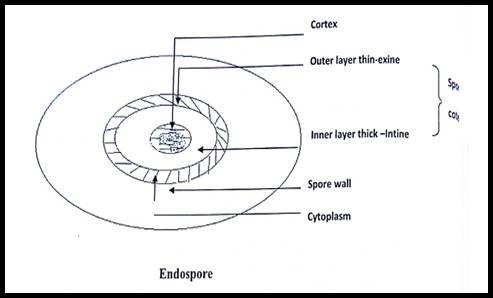
V) Endospore Formation in Bacteria:
Certain bacteria produce spores inside (within) the cell called endospores. The spore is a metabolically dormant form which, under appropriate conditions, can undergo germination and outgrowth to form a vegetative cell. These structures are unique to bacteria. These are thick-walled, highly refractile bodies that are produced (only one per cell) by Bacillus, Sporosarcina, Thermoactinomyces (all aerobic), Clostridium, Desulfotomaculum (anaerobic) and a few other genera.
बैक्टीरिया में एंडोस्पोर निर्माण:
कुछ बैक्टीरिया कोशिका के अंदर बीजाणु बनाते हैं जिन्हें एंडोस्पोर कहा जाता है। यह बीजाणु एक निष्क्रिय (dormant) अवस्था होती है जो उपयुक्त परिस्थितियों में अंकुरित होकर नई वनस्पतिक कोशिका बना सकती है। ये संरचनाएँ केवल बैक्टीरिया में पाई जाती हैं। ये मोटी दीवार वाले, चमकदार (refractile) शरीर होते हैं जो प्रति कोशिका केवल एक बनते हैं, जैसे Bacillus, Sporosarcina, Thermoactinomyces (एरोबिक), Clostridium, Desulfotomaculum (एनेरोबिक) आदि।
The shapes of endospores and also their location within the cell vary depending on the species. Ex.
Bacillus cereus : Spores are elliptical and centrally located.
Clostridium tetani : Spores are spherical and terminally located.
Clostridium subterminale: Spores are ovoid and sub-terminally located.
एंडोस्पोर का आकार और कोशिका में उनका स्थान प्रजाति के अनुसार अलग-अलग होता है। उदाहरण:
Bacillus cereus : बीजाणु अंडाकार होते हैं और बीच में स्थित होते हैं।
Clostridium tetani : बीजाणु गोलाकार होते हैं और अंत में स्थित होते हैं।
Clostridium subterminale: बीजाणु अंडाकार होते हैं और अंत के पास स्थित होते हैं।
Cells growing in rich media but which are approaching the end of active growth produce endospores. Ageing or heat treatment is needed to activate the dormant spores in a suitable medium. The endospores are extremely resistant to desiccation, staining, disinfectants, radiations and heat. Ex. Clostridium botulinum spores resist boiling for several hours. Most can resist treatment at 80°C for at least 10 minutes. During sporulation, dehydration of developing spores occus. The dehydrated mat be an important factor for heat resistance. All endospores contain dipicolinic acid (DPA) which accounts for 10-15% of spores’ dry weight. It occurs in combination with large amounts of Calcium and is probably located in the core (central part). The Ca-DPA complex formed at advanced stage may possibly play a role in the heat resistance of endospores.
समृद्ध माध्यम में बढ़ रही कोशिकाएँ जब सक्रिय वृद्धि के अंतिम चरण में पहुँचती हैं, तब एंडोस्पोर बनाती हैं। निष्क्रिय बीजाणुओं को सक्रिय करने के लिए उम्र बढ़ना या गर्मी उपचार आवश्यक होता है। एंडोस्पोर सूखापन, रंगाई, कीटाणुनाशक, विकिरण और गर्मी के प्रति अत्यधिक प्रतिरोधी होते हैं। उदाहरण: Clostridium botulinum के बीजाणु कई घंटों तक उबाल को सहन कर सकते हैं। अधिकांश 80°C पर कम से कम 10 मिनट तक सहन कर सकते हैं। स्पोर निर्माण के दौरान बीजाणु में पानी की कमी (dehydration) होती है, जो गर्मी प्रतिरोध में महत्वपूर्ण होती है। सभी एंडोस्पोर में डिपिकोलिनिक अम्ल (DPA) होता है जो सूखे वजन का 10-15% होता है। यह कैल्शियम के साथ मिलकर पाया जाता है और संभवतः कोर (केंद्रीय भाग) में स्थित होता है। Ca-DPA कॉम्प्लेक्स एंडोस्पोर की गर्मी प्रतिरोध क्षमता में महत्वपूर्ण भूमिका निभाता है।
DOWNLOD PDF OPEN
PPATH-122 Notes PDF FUNDAMENTALS OF PLANT PATHOLOGY 6th Deans Download